
Overview
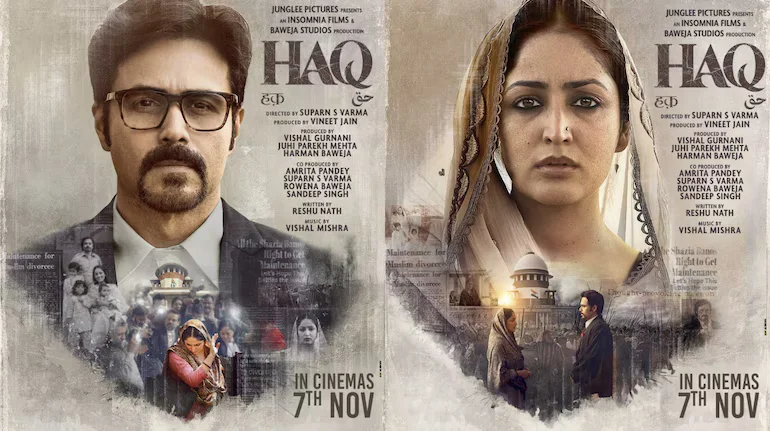
Haq (2025) is a courtroom-drama film that explores justice, law, religion, and women’s rights. Directed by Suparn S Varma, it blends legal-drama elements with emotional depth and social commentary — creating a movie that will appeal to audiences interested in socially relevant cinema, courtroom thrillers, and human-rights themes.
Key Production Details
- The film draws inspiration from real-life events (loosely based on the historic 1985 case concerning Muslim women’s right to maintenance after divorce).
- The screenplay attempts a dramatized but respectful portrayal of sensitive legal and social themes — faith vs. law, women’s rights, and social justice.
- Cinematography by Pratham Mehta and editing by Ninad Khanolkar aim to maintain a serious tone, reflecting the gravity of courtroom proceedings.
Because the film deals with law, religion, and social customs — all sensitive topics — the production appears to have taken care to balance dramatic storytelling with respect for the subject’s complexity.
Expected Release Platforms
The movie will be released theatrically (from 7 November 2025).
After the theatrical run, it is reportedly slated to stream digitally on Netflix — potentially from early January 2026.
Promotional Materials
The teaser and trailer of Haq have already generated buzz, showcasing intense courtroom scenes, emotional confrontations, and moral dilemmas.
The promotional campaign emphasizes the film’s central conflict — a woman’s fight for justice, her voice against social and religious suppression, and the challenge of reconciling faith, law, and equality.
What Is The Story About?
Haq follows Shazia Bano (portrayed by Yami Gautam Dhar), a woman who fights for her legal right to maintenance and justice after her husband abandons her and their children — a re-imagined version of a real, historic case that sparked national debate on women’s rights within religious and civil law.
Her husband, Mohammad Abbas Khan (played by Emraan Hashmi), remarries, leaving Shazia and their children without support — forcing her to resort to the courts to secure justice, challenging both personal faith and social norms.
The film explores core themes of justice, equality, faith vs. law, gender rights, and social reform.
Synopsis of the Plot
Set in a socio-legal context reminiscent of 1980s India, Shazia Bano — after being abandoned by her husband — fights a bruising legal battle for maintenance for herself and her children. When her husband remarries, she turns to the courts to demand what she believes is her rightful share under law, despite societal and religious backlash.
With the help of her lawyer (her estranged husband in this re-imagining), she challenges entrenched norms, confronts religious interpretations, and seeks a verdict that could resonate far beyond her personal family — triggering debates on women’s rights, religion, and justice.
She is supported (and opposed) by a host of characters: family members, religious figures, legal representatives, each representing different viewpoints — making the courtroom an arena for social conflict, moral ambiguity, and a fight for dignity.
Major Twists and Unique Plot Elements
A major twist arises from the moral conflict: the film doesn’t just depict a straightforward legal battle — it dramatizes the intersection of personal faith, religious law, and secular justice. The husband, who is also her lawyer (in dramatized version), adds emotional and ethical complexity: can one defend a cause they were party to? This internal conflict — lawyer vs. husband — leads to intense courtroom drama and emotional confrontations. (As adapted from the film’s promotional materials and plot hints.)
The film’s unique angle is that it humanizes the legal battle: rather than presenting it as mere courtroom rhetoric, it shows Shazia’s emotional turmoil, social ostracism, and moral courage — offering a dramatic yet sensitive portrayal of a woman’s fight for her rights within a religious and societal framework.
Backdrop and Themes
Backdrop: The film is rooted in the socio-legal and religious context of India, reminiscent of the 1980s — a time when legal battles around personal law, religion and women’s rights caused major national debates. This setting adds gravity and historical context to the narrative.
Themes:
- Courage & Resilience: Personal strength, moral courage, and speaking truth to power.
- Justice & Legal Rights: The struggle for legal maintenance, women’s rights post-divorce.
- Faith vs. Law: How religious practices and personal laws intersect (and sometimes clash) with secular justice.
- Gender Equality & Social Reform: The battle of an individual woman against patriarchal and religious norms.
Performances or Cast
Main Cast:
- Yami Gautam Dhar as Shazia Bano – The central protagonist, a woman fighting for her rights and justice after being abandoned by her husband.
- Emraan Hashmi as Mohammad Abbas Khan – Husband (and lawyer in the film) whose decisions trigger Shazia’s legal battle.
Supporting Cast:
- Vartika Singh as Saira – The second wife (in the film), adding complexity to the marital and legal conflict.
- Sheeba Chaddha, Danish Husain, S. M. Zaheer, Aseem Hattangady and others in significant roles – representing relatives, religious figures, and legal persons involved in the case.
Actor Preparation and Behind-the-Scenes
While specific details about actor preparation are not publicly disclosed, given the seriousness and sensitivity of the subject, it is reasonable to assume that leading actors — especially Yami Gautam and Emraan Hashmi — would have undergone research into the socio-legal context, character background, and emotional demands. The makers have shown commitment to authenticity: courtroom settings, careful dialogues, and an honest approach to social issues.
The director’s vision — to adapt a historically significant but controversial case into a socially relevant drama — shapes the film’s tone, where legal hearings, personal turmoil, and societal judgment collide.
Director’s Vision and Behind-the-Scenes Insight
Suparn S Varma’s direction promises a grounded yet emotionally powerful narrative. By choosing to portray a real-life-inspired legal battle, Varma’s approach seems to aim at not just drama, but social commentary — focusing on justice, faith, women’s rights, and the moral cost of change. The film’s narrative style reportedly tries to balance sensitivity with candor, avoiding sensationalism.
This vision ensures the film offers more than entertainment — it aims to provoke thought, evoke empathy, and encourage dialogue about legal and social equality.
Cinematography and Visual Style
With cinematography by Pratham Mehta and editing by Ninad Khanolkar, Haq offers a sober, realistic visual experience — appropriate for a courtroom drama dealing with legal and social issues.
The film likely uses restrained, realistic set design and lighting to reflect the gravity of courtrooms, the emotional weight of reunions, separations, and societal judgment. While there’s no major mention of flashy CGI or over-the-top effects — which suits the tone — the strength lies in intimate cinematography, focused framing, and an atmosphere that keeps viewers invested in the emotional and moral stakes.
Music and Sound Design
The music by Vishal Mishra aims to underscore the emotional and dramatic weight of the narrative — likely combining subtle background scores for courtroom tension, emotional scores for personal conflict, and songs (if any) that deepen the emotional bonding with characters.
Sound design and editing likely emphasize realism — courtroom silence, reverberation, whispered conversations, emotional breakdowns — enhancing immersion and audience empathy.
Cultural Impact and Social Relevance
Haq touches on significant themes: women’s rights, social justice, religious law vs. civil rights, and the struggle for equality. By dramatizing a real-life inspired case, it revives a historically important debate — making it both timely and relevant, in a society still grappling with gender justice and communal identities.
The film has the potential to resonate with global audiences interested in human rights, gender equality, legal justice, and stories of personal courage.
Audience Reception and Expectations
Audiences are eagerly anticipating Haq due to its socially relevant subject, strong lead actors, and compelling premise of justice and equality.
Early box office numbers (₹5.10 crore in two days) suggest healthy interest. Critics and commentators seem to appreciate its bold tackling of sensitive issues, its emotional depth, and its balance between law, faith and social justice.
Such reception indicates that Haq could be both a commercial success and a culturally significant film.
Budget and Box Office (Expected) Collection
Budget: (Not publicly disclosed.)
Box Office (Expected): Opening weekend has reportedly collected ~ ₹5.10 crore in first two days — promising for a serious drama.
Conclusion
Haq is poised to make a significant impact — offering a blend of courtroom drama, emotional depth, social commentary and justice. With strong performances, a committed director, thoughtful production, and a powerful real-life inspired narrative, it’s likely to captivate audiences who value meaningful cinema. Don’t miss it when it hits theaters on 7 November 2025.
Latest Movies