
Basic Details
From the streets of New Delhi to the grand sets of Bollywood, Aditya Dhar has carved a niche as one of the most decisive voices in modern Hindi cinema. Born on 12 March 1983 in New Delhi, Aditya Dhar’s journey from humble beginnings to National Award-winning filmmaker is as inspiring as it is compelling. Raised in a Kashmiri Pandit family, with his mother — Dr. Suneeta Dhar — once serving as the Dean & Head of the Faculty of Music & Fine Arts at the University of Delhi, he grew up in an environment rich with art, culture, and academia.
Early on, Dhar nurtured aspirations that went beyond conventional education. He was active in theatre through groups like the Delhi Music Theatre during his college years — a period that exposed him to storytelling, performance, and the magic of the stage. Yet, life had its share of detours: though he once dreamt of joining the Indian Army, fate led him to Mumbai instead, around the mid-2000s, determined to try his luck in the world of cinema.
Physical Stats and More
- Height
5′7″
- Weight
65 kg
- Eye Colour
Black
- Hair Colour
Black
Biography
Aditya Dhar’s early environment was steeped in culture, thanks to his mother’s academic standing in fine arts. This artistic exposure, combined with his own fascination for storytelling and performance, naturally led him to theatre. While in Delhi, Dhar spent significant time with the Delhi Music Theatre, honing his love for expression and narrative.
However, like many aspiring artists from non-film backgrounds, Dhar’s path was not direct. He harboured dreams of joining the Indian Army — a choice perhaps influenced by his Kashmiri roots and sense of duty. When that didn’t materialize, he pivoted toward cinema. In the mid-2000s, he relocated to Mumbai, willing to start from scratch and make his mark.
In Mumbai, Dhar began modestly — reportedly working as a radio jockey — but soon realized his writing and creative instincts were better suited for cinema. Over the years, he embraced multiple roles: lyricist, dialogue-writer, screen-writer. This phase of struggle, persistence and growth laid the foundation for what was to come: a directorial debut that would change everything.
His evolution — from small assignments to writing, then to directing major films — showcases a journey grounded in passion, patience, and hard work.
Relationships & More
Career
Aditya Dhar’s official entry into Bollywood began with lyrics. His first credited work as lyricist was for Kabul Express (2006). Over subsequent years, he wrote songs and dialogues for films like Haal‑e‑Dil (2008), Daddy Cool (2009), and also contributed dialogue and screenplay for films such as Aakrosh (2010) and Tezz (2012).
But the defining moment came in 2019 when he made his directorial debut with Uri: The Surgical Strike — a war-action film based on the real 2016 Uri attack. Dhar wrote, directed, and shaped the film’s screenplay. The film starred Vicky Kaushal, Yami Gautam among others.
“Uri” became a blockbuster — with a modest budget and a gripping narrative, it grossed ₹342 crore globally, becoming one of the highest-grossing Indian films of its time. Critically too, the film fetched acclaim. For this film, Dhar won the 66th National Film Award for Best Director (2019) and the Filmfare Award for Best Debut Director (2020) among other honours.
Post-“Uri,” Dhar expanded his scope by launching his own production banner, B62 Studios, in 2021.
He went on to contribute to the 2024 film Article 370 as a story and screenplay writer (produced under B62 Studios). As of 2025, his much-anticipated next directorial venture is Dhurandhar — a spy-action thriller starring Ranveer Singh and a stellar ensemble cast. The film is slated for release on 5 December 2025.
Through these choices, Dhar has demonstrated versatility — moving from lyricist to screenwriter to celebrated director and producer. His inclination toward socially relevant themes, patriotism, and emotionally intense narratives has defined his cinematic voice.
Other Details
- Hobbies
Theatre, writing, reportedly fond of cricket and creativity through storytelling.
- Favourite Actress
(Not publicly known / not reliably documented)
- Favourite Actors
(Not publicly known / not reliably documented)
- Favourite Movies
(Not publicly known / not reliably documented)
- Favourite Dishes
(Not publicly known / not reliably documented)
- Zodiac Sign
Pisces
- Caste
Kashmiri Pandit
- Religion
Hindu (Kashmiri Pandit heritage)
Contributions Beyond Work
While most known for his films, Dhar’s rise from writing lyrics, dialogues, and scripts before becoming a director exemplifies dedication and persistence — serving as inspiration for many young artists. His work — especially “Uri” — brought nationalistic themes, pride, and cinematic realism to mainstream cinema, influencing public conversations around patriotism and the sacrifices of armed forces. The fact that “How’s the Josh?” from Uri became a cultural phenomenon is testament to his impact.
The Legacy of Aditya Dhar
Aditya Dhar’s journey — from a theatre-loving Delhi boy with dreams, to a National Award-winning filmmaker shaping modern Bollywood narratives — stands as a testament to passion, persistence, and vision. His cinematic voice, rooted in realism, patriotism, and strong storytelling, has already left a lasting mark.
As his new film “Dhurandhar” readies for release, audiences and critics alike await with bated breath. Whether through war-dramas like “Uri”, socially relevant films like “Article 370”, or high-octane thrillers, Aditya Dhar continues to push boundaries.
Other Facts:
- Dhar belongs to a Kashmiri Pandit family and spent his childhood in New Delhi.
- His mother’s academic career in music and fine arts greatly influenced his creative sensitivity and storytelling skills.
- Before films, he was involved in theatre — performing and writing, which sharpened his narrative instincts.
- He also reportedly worked as a radio jockey upon moving to Mumbai — a humble start before entering mainstream cinema.
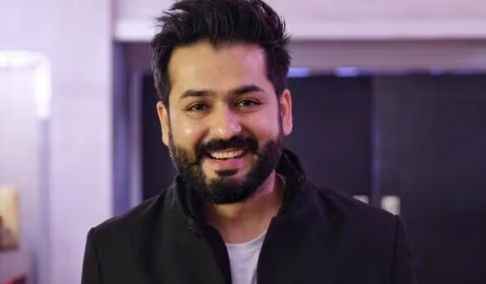
| Real Name | Aditya Dhar |
| Born | 12 March 1983 (age 43 years) |
| Nationality | Indian |
| Occupations | Director • Lyricist • Producer • Writer |
| Year Active | 2006 - Present |